Canon EOS Rebel T6s / 760D Review
Summary
 Canon's EOS 760D / Rebel T6s is a solid DSLR that represents a good stride-up over first appearance-level models. This has always been a very successful category for Canon, so information technology's not surprising to find the company now splitting it into two options: the EOS 750D / T6i gives you the core spec of 24 Megapixels, 19-point AF, 5fps burst shooting, pentamirror viewfinder, fully-jointed touchscreen and 1080p movies. Then if you fancy something a bit more than informed, spending an extra $100 USD / 70 GBP or so gets you the EOS 760D / T6s which adds an high LCD information screen, eye sensor, lift control wheel and finder levelling gauge, on with whole number zoom and HDR options for movies, and continuous AF in Loaded View. These additions add up to a camera that handles more than amend than its cheaper sibling and is advisable worth spending the unnecessary on, but as I feel mirrorless options much as Panasonic's Lumix G7 and Sony's A6000 crack more still to the target audience - compare closely if you're not wedded to the idea of having an sensory system viewfinder.
Corrupt it like a sho!
Check prices at Amazon, B&H, or Adorama. Alternatively get yourself a copy of my In Camera book or regale Maine to a coffee! Thanks!
Canon EOS Rebel T6s / 760D Review -
- Written by
In Depth
Canon's EOS 760D, operating room Rebel T6s A it's well-known in North America, is the company's latest upper entranceway-level DSLR. Announced in February 2015 and heir to the EOS 700D / Rebel T5i, it boosts the detector solution from 18 to 24 Megapixels (the highest yet for Canon's APS-C DSLRs), features an built crossbred AF organisation for movies, a new 7560 pixel metering sensor, a 19-point viewfinder AF system (inherited from the EOS 70D and a big improvement over the senior 9-point system), and becomes the first Rebel / xxxD to feature built-in WLAN with NFC. Like its predecessor, it's also fitted with a 3in fully-articulated touch-screen and a penta-mirror optical viewfinder.
Interestingly the 760D / T6s was announced alongside a slightly cheaper version called the 750D / T6i. This version lacks the upper data screen, center detector and rear control dial, on with the digital zoom and HDR modes for movies, and continuous AF in Live View. But at bottom, the sensor, silver screen, viewfinder, 5fps continuous shooting and 19-point viewfinder AF system are identical.
Having the two models is an intriguing scheme. The lower-conclusion T6i / 750D feels firmly in the upper submission-level tasteless, while the higher-end T6s / 760D feels more like a mid-range model, like the Eos 70D. In my critique I'll take an in-depth appear at the Eos 760D / T6s and how information technology compares not good to the 750D / T6i, only rival models including Nikon's D5500, Panasonic's Lumix G7 and Sony's A6000. If you're shopping for a step-high from a budget interchangeable lens photographic camera, you're in the right lieu!
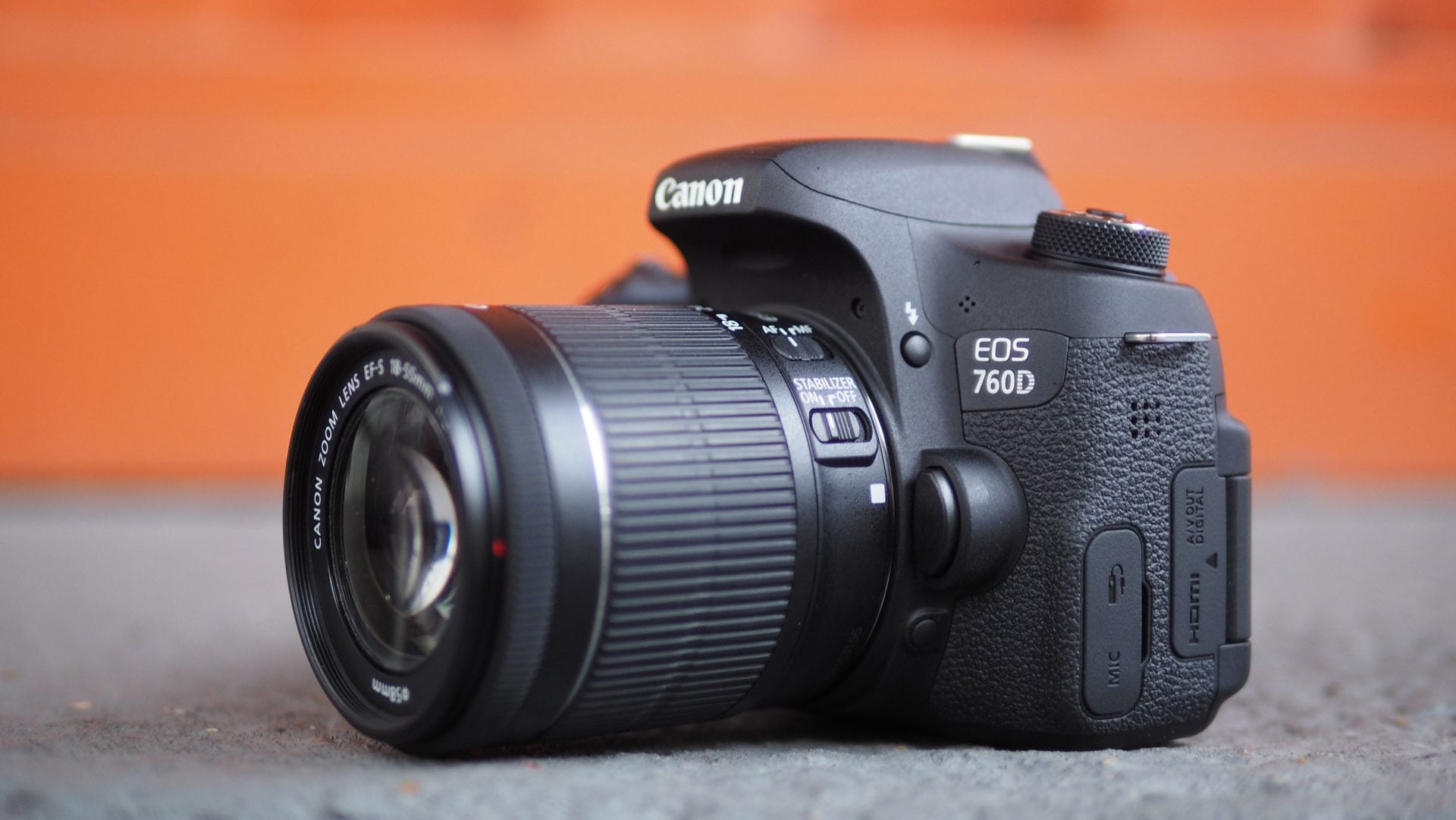
Canon Eos 760D / Rebel T6s excogitation and controls
Canon's EOS 760D / T6s is a traditional-looking for DSLR that's immediately perceptible Eastern Samoa part of the EOS family. The interesting part is how subtle design differences 'tween the 760D / T6s and its sibling, the 750D / T6i make them look for like quite polar cameras. With its upper Liquid crystal display panel, relocated mode dial and rear control wheel, the 760D / T6s looks nigher to middle-graze models like the 70D, while the design approach of the 750D / T6i makes it more akin to entry-level models like the 1200D / T5. I've pictured them incline-by-side below, albeit fitted with dissimilar lenses, so try to concentrate on the bodies! For me the 760D / T6s is a classier-looking camera, borrowing design cues from high-end models without their cost OR bulk. I've pictured them side-past-side below, with the 760D / T6s on the right field; bank bill they're fitted with varied lenses.

The EOS 760D / T6s is the largest of its peer group, measuring 132x101x78mm and weighing 565g with battery; note the 750D / T6i is exactly the same sizing, but 10g lighter. This makes the Canons chunkier all-round than Nikon's D5500, which measures 124x97x70mm and weighs 470g with battery, but both DSLRs persist comfortably larger than rival mirrorless cameras: Panasonic's Lumix G7 measures 125x86x77mm and weighs 410g with electric battery, spell Sony's topped A6000 is smaller and lighter still at 120x67x45mm and 344g with barrage fire.Attention deficit hyperactivity disorder their individual kit zooms and the differences become even greater, particularly for Canon who's EF-S 18-55mm STM doesn't collapse to relieve quad. I've pictured the EOS 760D / T6s below, aboard the Nikon D5500, then the Lumix G7 and finally the Sony A6000 for scale and it's clear how the Canon is the largest of the group, especially when fitted with their kit zooms. Obviously if you apply the EOS with the EF-S 18-135mm Short-term memory lens, it becomes even larger.
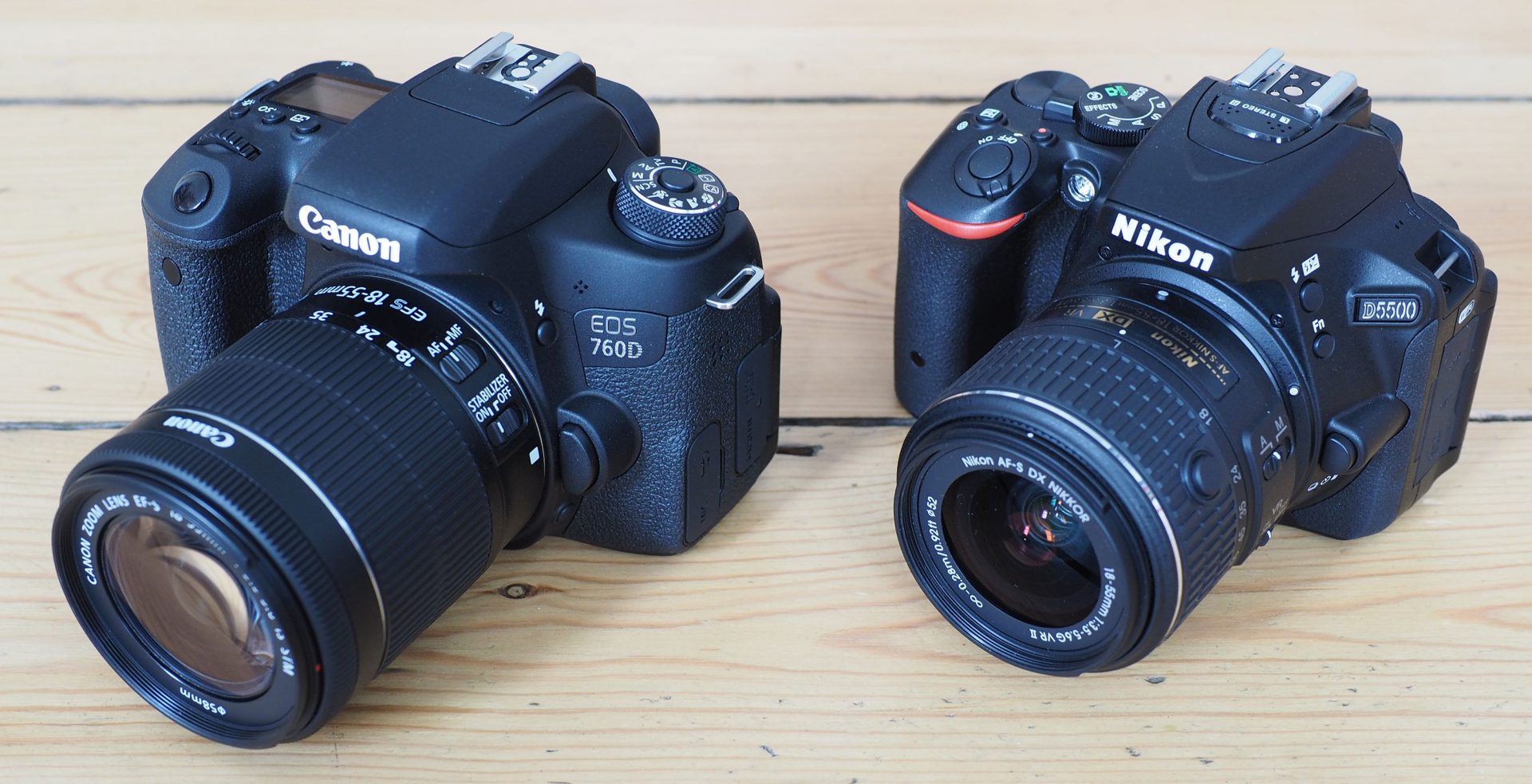
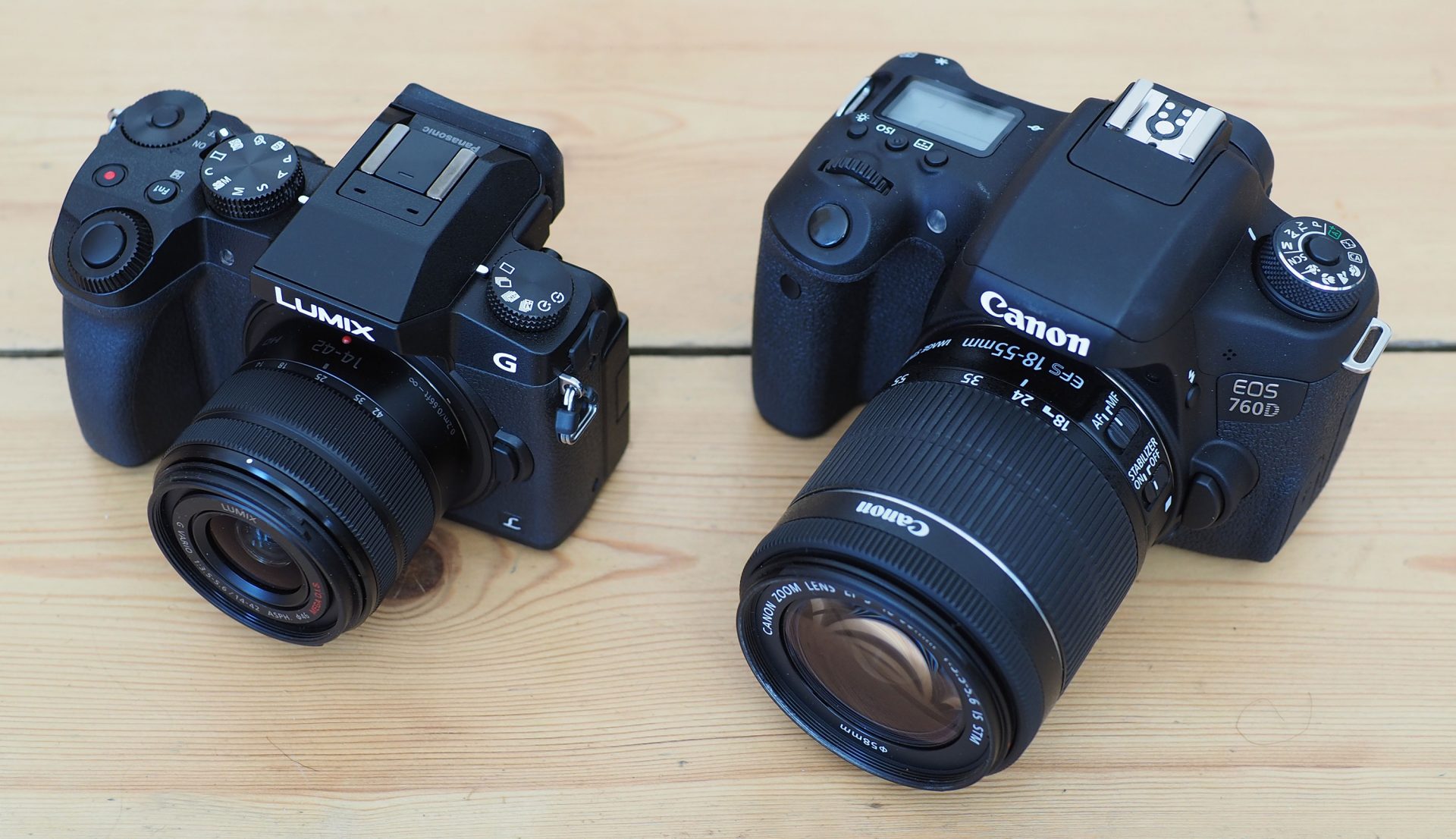

But little isn't necessarily always better. It's grievous to choose a camera that feels comfy in your hands. Personally tongued – and IT is a very syntactic category matter – the Canon 760D / T6s is verging happening being a tad too large for my hands. It certainly fills them and there's muckle to enwrap my fingers around, only for me I opt the slimly slimmer D5500 or G7 in my hands.
As for the kit zooms, I should as wel note collapsing models, such as those bundled by Nikon and Sony here, may save place, but in my tests are often lower calibre than non-collapsing designs. You'll encounter in my results pages how the Canon EF-S 18-55mm STM kit zoom maintains its acuity crosswise the frame much better than the Nikon DX 18-55mm VR II kit whizz which becomes quite an soft in the corners. Similarly for the Sony 16-50mm kit zoom, which may be a miracle of miniaturisation, but suffers from softness in the corners Eastern Samoa a result. I should devote a respectful nod then to Panasonic, who's 14-42mm kit zoom bundled with the G7 manages to be both small and high quality. Again you dismiss see how information technology compares against the Canon in my results pages.
It's also important to consider how well the controls work. The 760D / T6s is equipped with a finger dial behind the shutter release to boot to a thumb wheel on the rear. The latter is a key control difference betwixt the 760D / T6s and the cheaper 750D / T6i, which only has basic cross-keys on the rear. The dual controls of the 760D / T6s make it easier to conform exposure – for instance in Manual mode, the finger dial controls the shutter and the ovolo wheel around controls the aperture, while in the Av, Tv and P modes the rear wheel adjusts pic compensation.
Dual controls are an advantage the 760D / T6s also has over Nikon's D5500 which only has one dial for your thumb in the top true corner of the stern. I also feel the fingerbreadth telephone dial on both Canyon bodies feels fitter with more defined clicks and improved feedback than the D5500.
Simply the 760D / T6s isn't the only camera in its sort to boast similar control dials. Both Sony's A6000 and Panasonic's Lumix G7 have twin dials, and for me their smaller bodies allow me to more than easily reach either dial one-one-handed. The chunkier body of the Canyon means I generally need to readjust my grip or switch to ii-hands to turn the thumb wheel. Of course all of this is precise personal and you may find different models palpate better to you.
Looking at the other controls on the 760D / T6s, a trine position replacement around the mode dial switches the camera OFF, Happening and into movie mode. A button to the right of the viewfinder puts the camera into Live View if the intense switch is set to ON, or starts and stops recording video if the switch is laid to movie.
The rear see to it wheel can glucinium tilted up, drink down, odd or right and by default accesses the white res, Picture Style, drive mode operating theatre AF mode respectively. There's a pair of buttons alongside the upper LCD screen to accession the AF area / zone options and the ISO sensitivity. The Set down button in the in-between of the rear wheel can live customised, but only from a fistful of options, some of which like ISO are duplicated by buttons elsewhere.
Nikon's D5500 does slightly better for customisation with a single Fn button and a muted Fn button (on-screen), both of which rump equal set from a broad list of options; in that location's also the chance to reassign the AE / AF lock up button (albeit only to AE / AF operations). Just this pales alongside models like the Lumix G7 which boasts no few than 11 customisable function buttons (six physical and five soft, via the screen). The degree of customisation offered by Nikon and especially Canon present places their models on the simpler end of the spectrum.
Something that makes the 760D / T6s unique amongst rivals though is its upper LCD information covert – indeed it's other Florida key difference with the cheaper 750D / T6i. It's moderately staple compared to semitrailer-pro bodies, but still shows you the shutter stop number, aperture, exposure recompense scale, ISO value and shots remaining, on with indicators for battery life and whether Wifi or Highlight Tone Priority are enabled. Of course the main screen along the rear shows a lot more shot information, but it's still nice to have the most key inside information at a glance happening the top, specially if the main screen is folded back connected itself for protection or to save power. The top empanel as wel has an optional orange backlight.
For musical composition you take over the choice of an optical viewfinder or Live View on the fully-articulated touchscreen. Like the D5500, the 760D / T6s has a law of proximity sensor 'tween the finder and hotshoe which can turn the screen off when you bring your eye to the tv camera; this is disabled during Live Horizon. Short letter the cheaper 750D / T6i lacks the optic sensor.
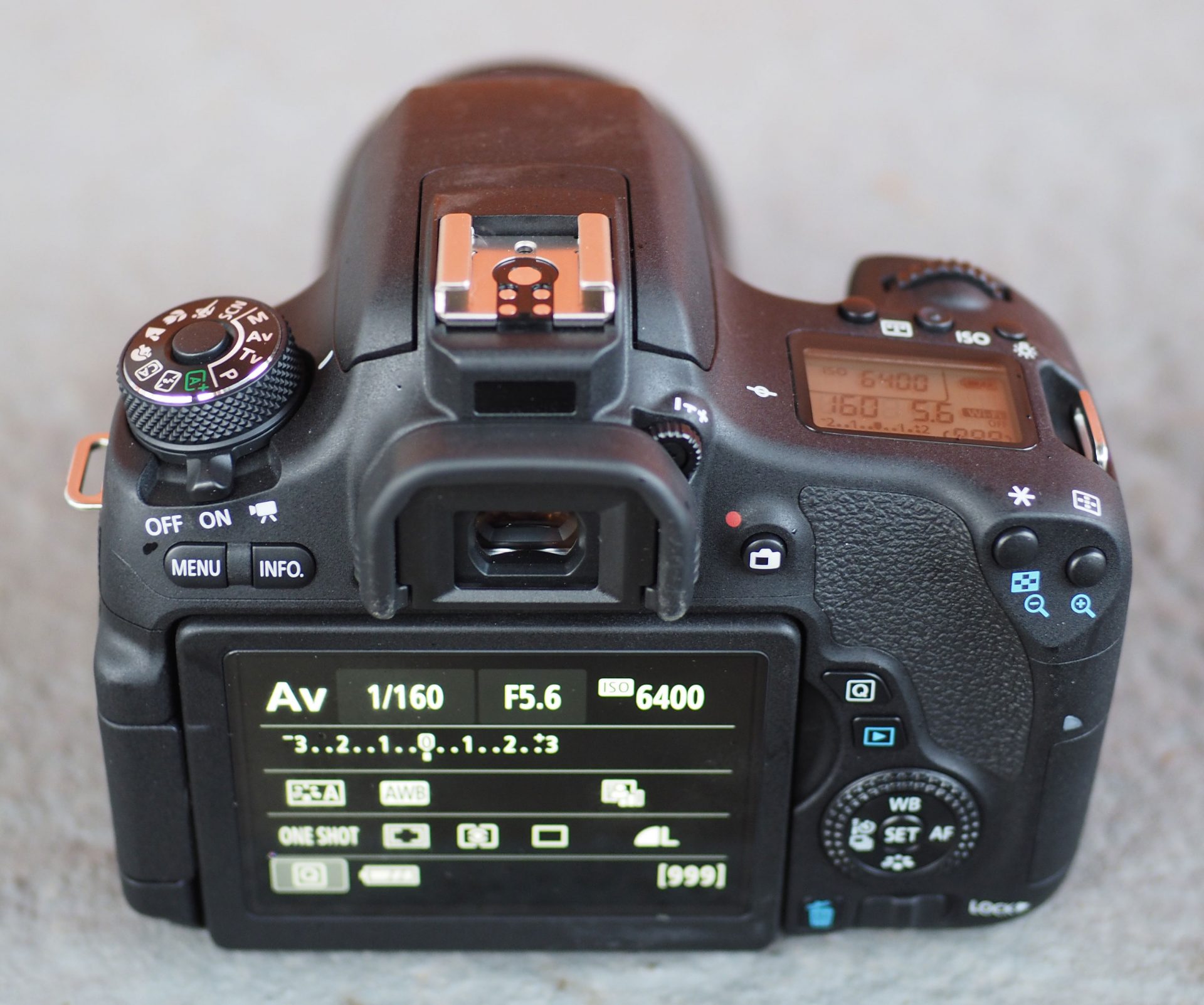
The exteroception viewfinder in both Canon models delivers 95% reportage with 0.82x magnification and the take chances to enable an LCD alignment power system; the 760D / T6s also gives you the option to reckon a simple levelling graphic in the lower left turning point which indicates if you'Re horizontally tilted left Oregon right, or if you're level.
The coverage and magnification is roughly comparable to the optical viewfinder in Nikon's D5500, but information technology's deserving noting mirrorless cameras with electronic viewfinders typically deliver a much bigger image to write with: the viewfinders in Panasonic's Lumix G7 and Sony's Alpha A6000 for example deliver an prototype that's a quarter to a third taller and wider, with 100% reporting that means what you see is what you'll aim. In that respect's pros and cons to optical and electronic viewfinders, with fans of sense modality citing longer battery life, a cleanser view in very low light and zero dawdle when panning to travel along subjects, only for Pine Tree State the bigger image, full coverage, focusing aids and effect previews make believe electronic viewfinders in the end more compelling, especially at this end of the grocery store. The fact is, the optical viewfinders in entry-level and middle-range DSLRs are typically really pocket-sized and don't demonstrate the whole painting.
I have no complaints with Canyon's riddle though. The EOS 760D / T6s is equipped with a 3in touchscreen on a fully-articulated, side-hinged climb, allowing it to flip and twist to any angle, including forward to face the case Beaver State back happening itself for protection. The 3:2 aspect ratio matches the native figure of speech forge, and the 1040k dot resolution delivers a crisp view in Live View and playback.
Canyon's touch-sieve interface whole shebang identical well. It lets you tap your way through the integral menu system if desired, including the ability to quickly enter copyright details using an along-screen keypad. You can do all this with the rocker control if you prefer, just I found it quicker and easier with the sort. In playback you can swipe through images and pinch to soar Eastern Samoa you would with your phone. It all feels selfsame natural and intuitive.
But IT's when shooting in Live View where the touchscreen really comes into its ain. In one case you're in Resilient View you can tap about anywhere happening-screen to reposition the AF area and if you like, also enable a tap-shutter. For Maine, the ability to tap to storage the AF area is incredibly usable and I'm gladiolus to find it here.
But there's much. Pressing the Info button cycles through and through various views: clean, basic shooting information, detailed shooting information, then the latter with either a springy brightness histogram or a single axis levelling gauge (note Canon's specs arrogate it's a multiple-Axis gage in Live View, but I could entirely see a sole). If you have the grid enabled, it'll be super-obligatory on complete views; there's two grids to choose from.
In the views with basic or detailed shooting information, you can utilization the touchscreen to tap the shutter speed, aperture surgery ISO values and adjust them directly happening-screen. Tapping the magnifying glass icon in the lower right street corner superimposes a small windowpane connected the view which you can drag or so with your finger to the desired area, after which tapping it again magnifies the selected panoram by five or ten multiplication. Once you're in the exaggerated views, you can tap arrows to reposition the selected area or use the tilting rocker.
Canyon has always delivered a clean and detailed magnified image in Live View, which makes it easy to adjust the rive, only you know what would go far even easier? Yep, focus peaking, especially for movies where the exaggerated view becomes disabled once you start filming. Focus peaking is a feature that's standard on most mirrorless cameras at this damage point, simply it's sadly absent here, as are zebra patterns. Nikon's no better in this involve, but that's none apologize.
Backward to the touchscreen, tapping the present Q in the top right corner presents fivesome settings on the left side and four on the right which you can tap to adjust: these include the AF area, AF way, private road mode, metering mode, image character, white balance, Picture Style, Motorcar Lighting Optimiser and, if RAW is not selected, a selection of Creative Filters which I'll cover advanced.
In terms of connectivity, there's ii rubber flaps on the left side of the body. Behind one you'll find a combined Ab / TV output and a (refreshingly large) Mini HDMI port, and behind the other is a 3.5mm mic input and a 2.5mm manual laborer for the optional RS-60E3 cabled release. If you prefer to wirelessly trigger off the shutter, there's an IR sensor on the front which works with the optional RC-6 unlikely, or you could connect the camera o'er Wifi to an iOS or Android smartphone and use the Canon app; I'll talk about the WLAN capabilities in contingent tardive.
On the top of the inning of the body you'll find a hotshoe which can accommodate Speedlite flashguns. There's besides a popup flash with a Guide Numeral of 12 at 100 ISO which can likewise be used arsenic a wireless commander for multiple flash setups. GN 12 is the comparable as the Nikon D5500, but both are more superhuman than the Lumix G7's built-in flash which only has a Guide Number of 6.6 at 100 ISO.
Like the D5500, but unlike most mirrorless cameras in this class, the Mount Rushmore State slot is housed in the grip, allowing you to easy change cards while the camera's mounted on a tripod. Mirrorless cameras equal the Lumix G7 and Sony A6000 accommodate their SD slots inside their battery compartments which rear end sometimes become blocked when mounted on a tripod.
Talking of which, the EOS 760D / T6s is supercharged aside an LP-E17 / 1040mAh Lithium Ion pack that's charged using an outer AC charger; no USB charging Hera. Canyon quotes a battery life of 440 shots using the optical viewfinder which is much less than Nikon quotes for the D5500, but about a poop more than you'll typically reach with a mirrorless camera alike the A6000 or G7. If you mostly use the 760D / T6s in Live Scene though, the battery life is quoted at 200 shots.
If you fancy doubling your battery life you can besides go for the optional BG-E180 stamp battery grip which can accommodate two packs, while also proving a portrait grip and controls; an official battery grip is a fairly unusual accessory for a camera therein cost bracket and an advantage the 760D / T6s has concluded most of its rivals, although there are third party options for the D5500.
Canyon Eos 760D / Renegade T6s lenses
Canyon's EOS 760D / Rebel T6s is equipped with an EF mount that lets it to role whatever of the EF or EF-S lenses in the extensive Canon catalog. And comprehensive is the right word too with no fewer than 76 lenses listed in the current range at the metre of writing, natural covering focal lengths from 8mm to 800mm with everything mediate including six large and four tilt shift options. Having access to this broad array of lenses, not to mention a number of discontinued options, is one of the key benefits of choosing the Canon arrangement, although Nikon comes close and in the mirrorless Creation, Small Cardinal Thirds is leading the pack.
With an APS-C sensing element, the EOS 760D / T6s reduces the field of survey of all lenses by 1.6 multiplication, so the EF-S 18-55mm f3.5-5.6 Immediate memory and EF-S 18-135mm f3.5-5.6 STM kit zooms deliver 29-88mm and 29-216mm effective coverage severally. I've illustrated their relative coverage at a lower place, starting with the 18-55mm, then the 18-135mm; both were adorned on the synoptical body moments divided.

Above: Canyon EF-S 18-55mm STM coverage, at 18mm (left) and at 55mm (right)

Above: Canon EF-S 18-135mm Immediate memory coverage, at 18mm (left) and at 135mm (right)
Contingent where you are, the 760D / T6s whitethorn be getable in a kit with either the EF-S 18-55mm f3.5-5.6 Immediate memory or the EF-S 18-135mm f3.5-5.6 zooms; at the time of writing, the latter was a much common pick. Both are fairly substantial lenses, with Canon choosing not to embrace the trend for designs that collapse to save blank space. Merely what they lack in miniaturisation, they make in quality. Some of the Canyon Short-term memory kit zooms deliver respectably sharp inside information across their frames, and spell you shouldn't have a bun in the oven miracles, they did down-do collapsing kit zooms from rivals.
Both the kit zooms also feature Canon's Short-term memory focusing system, which promises smoother focusing for movies and in liveborn view. But non completely STM lenses are created equal. Canon in reality has two different types of focusing motors for its STM organisation: the appurtenance-type are employed in the smaller lenses such as primes like the EF 50mm f1.8 STM, while the lead-type are exploited in larger-barrelled models like the kit out zooms. You can check the EF 50mm f1.8 STM mounted on the 760D / T6s beneath and alongside it the EF-S 18-55mm STM kit zoom.

The good news for owners of the kit zooms is that lead-type motors are quick and quiet, compared to the slower and louder focusing of the gear-type. Indeed when you'atomic number 75 exploited to the focusing with the STM kit up zooms, it can be quite an surprisal to switch to STM primes that employ the slower and louder motors. Sadly the new EF 50mm f1.8 STM is unrivalled of those models with the lower and louder gear-type motors, but it remains one of the best ordinal lenses for Canon owners wanting to search shallow depth-of-area personal effects and portrait photography. Here's an example enamored the EOS 760D / T6s and EF 50mm f1.8 STM at f1.8, where the flying field reducing delivers an 80mm equivalent field of view that's consummate for portraits.

Above: Canyon EOS 760D / T6s with EF 50mm f1.8 Immediate memory at f1.8
Canon Eos 760D / Rebel T6s shot experience
The EOS 760D / T6s feels like a homey increase from an entry-level DSLR – the solid habitus, generous hairgrip and nicely textured surface loan it an air of trust that punches above its weight. American Samoa I noted earlier in the review, the addition of the upper LCD screen, rear ascendancy wheel and repositioned mode dial pull round look and tactile property more serious than its slightly cheaper sib, the 750D / T6i.
Having dual controls makes a bad difference to how quickly the camera handles, allowing you to easy make adjustments to exposure, while the mien of the upper screen lets you check those settings at a glance. They sound like minor additions to the al-Qaida model, but they significantly improve the shooting experience and for me score it worth spending the extra on the 760D / T6s.
Canon's experience in biotechnology besides shows here with advantageously-placed controls and buttons, complemented by one of the best touch-screen interfaces or so. You ass sail the full menu or playback systems and adjust all but any aspect of the television camera aside touch if you like, or change over to the traditional physical controls if preferred. It all comes in collaboration very well in practise.
The viewfinder Crataegus laevigata drive home a smaller view than rival mirrorless cameras, merely IT's on-equality with DSLRs in this price bracket and of course gives the vantage of longer battery life and no lag. If you prefer shot in Live View, the fully-articulated screen lets you compose at any angle operating theater position, and past offer this additionally to an optical viewfinder you arguably have the best of both worlds.
The main mode dial offers the usual PASM options, along with full Auto, no flash, Creative Auto (with a five position slider on-screen to control deepness-of-field), manoeuver admittance to four nonclassical scene presets and a SCN position which presents on-screen access to six more, including HDR Backlight Control which I'll talk about in a here and now. A squashy lock-button midmost of the dial needs to be pushed land to cause any changes, preventing unwanted surprises.
The shutter is all natural philosophy with an vulnerability mountain chain of 1/4000 to 30 seconds. Again this is equality for the course for a DSLR therein price bracket, but it's important to note many mirrorless cameras now provide you to dial-in exposures as long equally 60 seconds without resorting to Bulb surgery remote control controls, and can also deploy faster speeds with the help of an lepton shutter; for good example the Lumix G7's electronic shutter allows it to shoot at busy 1/16000, which is of import for using large apertures in bright conditions.
Electronic shutters also have the do good of shooting in genuine silence, whereas the EOS 760D / T6s 'Silent' ram option is only fractionally quieter than the standard shutter. Straightaway don't catch me wrong, electronic shutters are far from perfect: they can suffer from skewing artefacts when the affected or camera is in libertine motion, but the risk to shoot discreetly without making a sound is smooth a important readiness when you're shooting street, events, ceremonies or jittery wildlife.
As a sub-mid-lay out model, the EOS 760D / T6s also has fairly qualified exposure bracketing: reasonable the basic threesome frames, up to 2EV apart. Nikon may also proffer three frame bracketing, but others try harder: the Lumix G7 features seven-compose bracketing up to 1EV apart.
The HDR Backlight Control, accessed from the SCN position on the dial, takes three exposures and combines them into one in-camera to increase the tonal range. There's nobelium contain terminated the bracketing range, aperture, ISO or the compositing process which, like all but in-camera HDR modes, incurs a small dress. Here's how it looks on the inner of the Brighton Dome, where information technology's distinct how the HDR rendering has greatly boosted the mid and shade regions.


Above: Canon EOS 760D / T6s HDR Backlight Control, disabled (left-of-center) and enabled (right)
Uniquely, the EOS 760D / T6s allows you to apply HDR personal effects to movies, albeit at a shrivelled settlement of 720 / 25p / 30p. The HDR selection also only appears if you have the mode dial outside of PASM, and again there's minimal control. I asked Canon how it works and they explained IT shoots at 50p / 60p, alternating between a even out exposure and an complete-photo. These are then combined into a 25p / 30p TV with increased can-do range.
I dependable the HDR movie way outdoors in advanced and backlit scenarios and power saw little difference of opinion between IT and my non-HDR footage. The biggest difference I saw was when shot inside with powerfully backlit windows, so here's an example I filmed at the Brighton Dome again.
Above: Download the original file (Registered members of Vimeo exclusive). Canon's EOS 760D / T6s unambiguously offers an HDR option for movies that actually grabs and combines two seperate exposures to generate a 720p clip at 25p or 30p. Preceding is with the HDR mode enabled. The version without HDR can exist viewed and downloaded here. I've ready-made screengreabs and histograms of both to a lower place for comparison.


Above: Canon Eos 760D / T6s HDR Pic mode, disabled (left) and enabled (redress)
Above I've taken screengrabs from the versions without and with the HDR movie mode, accompanied by histograms to better suggest the tonal differences. Eastern Samoa you can see, the biggest difference is in the extreme highlights with less clipping on the version with HDR applied (which is the opposition I'd expect if the second exposure is over-exposed rather than under as claimed), but with fewer impact than the version on the still photos above. Silent, at that place is a difference, soh it's a tool you may find usable in some situations and it likewise gives a taste of what we send away expect from future cameras with shrilling frame rates at their disposal.
If you fancy applying separate effects to your images, the 760D / T6s offers a alternative of seven Creative Filters: Grainy Soiled and White, Soft Focus, Fish-middle, Art Bold, Water House painting, Toy Camera OR Miniature. Kind of than selecting them via the musical mode dial though, you'll need to recruit Live View, and even past they're only for sale when you'Re recording in JPEG, non RAW. So you can't shoot personal effects if you'Ra composing with the viewfinder and they're as wel permanent, merely at to the lowest degree forcing you to utilize Live View means you throne instantly preview their impact. Here's the introductory six of them.

To a higher place: Canon EOS 760D / T6s Creative Filter: Grainy Black and White (left), Soft Stress (exact)

Above: Canon EOS 760D / T6s Creative Separate out: Fish-eye (left), Art Bold (right)

Above: Canon EOS 760D / T6s Creative Filter: Water Painting (left), Toy Camera (right)
If the camera's set to movie mode, the Creative Filter menu is replaced with a single option to enable a Miniature effect, and refreshfully Canon forthwith allows you to apply IT to videos recorded at the uttermost resolution of 1080p. Previously there was zero way to implement a miniature set up on movies filmed with Canon DSLRs, and the process for its compacts – including the EOS M3 – was slightly complex. You needed to to enter the effects mode, select Small, past press record, but if you wanted the picture in widescreen HD, you'd number 1 call for to set the pic aspect ratio to 16:9, and even then the quality maxxed-impossible at 720p. So to possess the choice plainly presented in the moving-picture show mode is a very wanted update. Hither's how it looks with the default settings.
Above: Download the original lodge (Registered members of Vimeo only). Hither's the Miniature Effect applied to a movie, by simply choosing the effect from the Q menu then pressing the picture record button. This inherits the selected caliber up to 1080 / 30p.
At this point I'd normally discuss the timelapse and panorama facilities, but sadly the Eos 760D / T6s continues Canon's to a lesser extent than proud custom of non oblation either. Nikon's D5500 does better away oblation a built-in interval timer, just models like Panasonic's Lumix G7 take the pass with both panorama and timelapse facilities, the latter even offering to code the sequence as a video skyward to 4k in quality. Again other expanse where Canon looks old designed.
In terms of break shooting, the Eos 760D / T6s offers two options: Continuous and Continuous (Soundless). I tested it with a fast-breaking and freshly-formatted SD card with the shutter set to 1/500, the sensibility to 400 ISO and the focus localise to one-on-one.
With the quality set to Large Close-grained JPEG, and composing through the optical viewfinder, I discharged-off 30 frames in 6.08 seconds for a speed of 4.93fps, after which the rate slowed to about 3fps. With the calibre set to RAW, the 760D / T6s fired-off seven frames in 1.24 seconds for a speed of 5.65fps, then slowed massively to peerless frame all two seconds surgery so.
In silent mode, the camera slows down to reduce the volume of the shutter and mirror mechanism. With the 760D / T6s set to Large Fine JPEG I took 20 shots in 6.41 seconds, for a speed of 3.1fps. So almost half the hasten, simply was it whatever quieter? Yes, merely like the single shot 'inaudible' mode, only by a teeny fraction. The 'silent' modes on the Canyon are still very audible. I also tried the constant shooting in Endure View. I fired-off 24 frames in 4.51 seconds, resulting in a speed of 5.3fps, before it slowed down to nearly 2.5fps.
Thus whether you're shooting with the viewfinder or in Live Sentiment, the EOS 760D / T6s delivers its quoted speed of 5fps, thereby matching the Nikon D5500, albeit with a smaller buffer in my tests. But again you can do better for the money if fit shooting is your thing. Panasonic's Lumix G7 will shoot at 6fps with continuous AF or 8fps if you Don River't indigence tracking, while Sony's A6000 remains the leader at this price tip, firing-off 11fps with continuous AF crossways the frame.
Which brings me to autofocus on the Canyon. The Eos 760D / T6s has deuce AF systems, depending happening whether you're composition with the optical viewfinder, or the screen in Live View. I'll cover each in turn.
When composing with the handed-down optical viewfinder, the Eos 760D / T6s employs a 19-point / all hybridizing-type system inherited from the EOS 70D which operates push down to light levels of -0.5 EV; if lenses slower than f2.8 are used, such as the kit out zooms, only the central 7 points rest cross-eccentric. Nikon's D5500 has more AF points (39 in unconditional), but fewer that are of the more sensitive cross-type (nine); its minimum operating light level is a trifle let down at -1 Electron volt. Note the earlier Eos 700D / T5i had a 9-point / all cross-type AF arrangement.
A dedicated AF zone button away the LCD screen toggles the tv camera 'tween single AF (where you can choose whatever of the 19 points manually), district AF (splitting the array into five regions you can choose from) and full which automatically selects from the stallion 19-point array. As always you can choose from Unmatchable Shot (Single), AI Control system (Continuous) OR AI Focus (which automatically switches 'tween them).
When shooting through the finder the AF performance is greatly dependent happening the lens. I'm pleased to suppose the STM kit up zooms are very fast (and real quiet too), snapping-onto the subject almost instantly even from the nearest focusing distance to infinity or book binding, so long equally there's decent demarcation; the 760D / T6s with its STM outfit zooms is certainly faster and quieter than the D5500 with its DX kit zooms. Other Canon lenses tin can be more leisurely though, such as the EF 50mm f1.8 STM, which can take a second or so to adjust, especially if it's from near to far or contrariwise.
Set to AI Servo, the EOS 760D / T6s does a fair job at trailing action, again depending happening the crystalline lens you have mounted. In my tests the maximum burst rate of 5fps could embody maintained with dogging AF, although I enjoyed a higher success rate of centralised images with the STM kit zooms than the EF 50mm f1.8 STM or EF 85mm f1.8 USM, partly due to their inherently larger and more forgiving deepness of field, but also imputable the single focalisation mechanisms and motors. I tried multiple combinations with upcoming cyclists or kids running towards me and I'd say three to quartet out of five frames were intense or mostly sharp. So in this respect it performs similarly to the Nikon D5500, although revealingly most rival mirrorless cameras will out-perform them in this reckon, delivering continuous AF at high frame rates.
Moving onto AF in Live Look at, the EOS 760D / T6s employs Canon's Hybrid CMOS AF III which combines contrast-founded AF with a number of integrated phase-detect AF points along the sensor itself, cover or s 80% of the horizontal and hierarchical area of the frame.
In that location's three AF modes: Face off / Tracking (which identifies and follows detected faces), Flexizone Multi (where the camera automatically chooses from a 49-area array), and Flexizone Single (where you can set back a single AF area almost anyplace on the screen, aside touch if desired). In any of the three modes you can enable Continuous AF which instructs the photographic camera to continuously adjust during composition. Meanwhile if you'd like to rails subjects while in reality shot a burst, you need to enable Servo AF, but this option is only available on the higher-stop EOS 760D / T6s – the cheaper 750D / T6i lacks the ability to continuously autofocus in Live View.
One of the benefits of shooting in Hold ou View is being able to focus almost anywhere on the frame, as oppose to within a little baseball field pattern in the viewfinder. In practice, the 760D / T6s lets you do this and I enjoyed exploitation the touchscreen to shift the single AF area about. Fitted with an STM kit up soar, the focusing was confident and very swift, locking-on about instantly and avoiding any search thanks to the embedded phase-detect system.
Other lenses weren't as fast though: the EF 50mm f1.8 STM and EF 85mm f1.8 USM could take a second or more to lock-along. I plant this preventive when shooting portraits with face detection where the experience was considerably slower than, say, a bright lens on a Panasonic Oregon Olympus television camera. Over again the STM kit zooms were much quicker than the Canon primes I tested, just you give shallow depth of field personal effects with them. I shot this succeeding image with the EF 85mm f1.8 at f1.8 in Live View – fortunately I had a patient issue, thanks Ashley!

Above: Canon EOS 760D / T6s with EF 85mm f1.8 at f1.8
To test the Control system AF in Live View, I photographed people walking or running towards Maine using the Face off / Tracking AF mode and burst shooting. As with the viewfinder, the results were very lens-dependant with the STM outfit zooms delivering the prizewinning results. When I switched to the EF 50mm f1.8 STM and EF 85mm f1.8 lenses, some unlawful at f1.8, the camera could sporty some deal with a slow and steady pace, but whatsoever quicker and it floundered. Again this is an field where most mirrorless cameras could match or exceed the performance.
So at this point you have to expect yourself whether you'll mostly scud through the sense organ viewfinder or in Live View with the screen; if the latter, and so you'll be better-served by a mirrorless camera. I should also add that while Canon doesn't quote the promiscuous levels that the live on view can autofocus under, it does pronounce the viewfinder AF system whole caboodle down to -0.5 EV. Compare that to, suppose, the Lumix G7 which send away focus on in levels down to -4 Electron volt and you'll find the Canon troubled as light levels become very low. For me, the ability to focus without fuss in low tripping is a valuable capableness.
Just a quick note on manual focussing aids: the EOS 760D / T6s does let you magnify the image in Go Aspect by five or cardinal multiplication, but deplorably lacks focus on peaking, over again something that's increasingly provided happening mirrorless cameras.
Finally therein section I wanted to discuss the Wireless local area network capabilities, amazingly the first time Canon's equipped an xxxD / Rebel model with them – so welcome to the futurity Canon. Wifi on the 760D / T6s lets you wirelessly send images to compatible cameras, Wireless local area network printers, media players, or to Canon's Image Gateway which force out past post them to various social services on your behalf. It also supports wireless image transfer and remote control with iOS and Android smartphones, and I'll center that panorama here. I tested the EOS 760D / T6s with my Samsung Galaxy S6 using Canon's free Tv camera Unite app downloaded from the Playing period Store.
Like most cameras that have Wifi, the EOS 760D / T6s sets itself sprouted as an access point which your phone needs to connect to. If your phone doesn't ingest NFC, you'll involve to start Wifi on the camera, then manually select it from your phone's WLAN browser, before entering the password displayed on the camera's screen; sadly on that point's no shortcut by scanning a QR inscribe. If your phone does have NFC, as my Galaxy S6 does, you only need to hold out it against the camera for a moment for them to negotiate the meshwork selection and password entry themselves. In either case though, you'll need to manually enable Wifi on your phone front.

Once connected the Camera Connect app presents three options: Images on Television camera, Remote Shooting and Camera Settings. The first lets you browse the table of contents of the camera's memory card as thumbnails. You can then tap the one you want and copy it over to your phone if in demand, either at a reduced resolution (1920×1280 on my ring) OR at the original size capable 6000×4000 pixels. When copying originals from a distance of about 1 meter, it took virtually one second per Megabyte – so typical images mensuration around 5MB took active fin seconds to transfer. Note it's not possible to transcript RAW or movie files.
Flying on, the Unaccessible Shooting option fires-up the camera's Live Sight, presenting a live image on your phone's screen. If the lens is set to autofocus you can pat anyplace happening the live image to reposition the AF area; if the lens is set to manual focus, you can use buttons on-screen to nudge the focus back and forth by script.

Depending happening the shooting mode, the app lets you remotely adjust the shutter fastness, aperture and ISO, on with the AF area and ram modes. The live in catch can also be overlying with additional inside information including the white equilibrise, metering mode and image quality, but deplorably you can't change any of them remotely. You'atomic number 75 besides unable to trigger a video recording remotely either.
Finally, the Camera Settings page basically lets you sync the time between the camera and phone, hinting at afterward syncing a GPS log, merely I couldn't find any location options to cause thusly.
Since most other Wifi-weaponed cameras grant you all of this along with the opportunity to trigger movies and record a GPS log, the Canon Camera Unite app feels a bit light in comparison. That said I did like the way you could play an prototype on the camera, then simply have got an NFC-enabled phone against it to initiate a transfer without bothering with the app. Sure, Sony's offered the same functionality for ages, but for a past-ish adoptive parent of Wifi and NFC, I'm glad Canon's included this feature. Let's hope future versions of the app declare oneself the chance to entrance a movie and a GPS logarithm, on with offering QR code configuration for those who don't let NFC.
Canon EOS 760D / Rebel T6s movie mode
The EOS 760D / T6s offers Canyon's usual DSLR movie capabilities with a couple of enhancements. The maximum caliber is 1080 at 24, 25 or 30fps, there's an external microphone input, adaptable sound levels, manual check concluded photo, and uninterrupted autofocus while cinematography, including the ability to root focus using the touchscreen.
As the competition commonly offer 1080 at 50p and 60p, it's unsatisfactory to find Canon standing hush up at this end of the market with 1080 at 30p – and lest we forget Panasonic now likewise lets you movie in 4k at this toll point with the Lumix G7. Canyon does at least offer two choice options for video, with 1080 in Standard and Light modes overwhelming 216 and 87 Megabytes per minute respectively. The maximum transcription fourth dimension on all models, whether in Europe or not, is 29:59 with the footage split into 4GB chunks.
The good news is Canon's Interbred CMOS AF III sensor with embedded form-detect AF points does a good caper at driving lenses in the right direction and stopping when focus is achieved. Fit the camera with cardinal of Canyon's STM zoom lenses which feature the company's faster and quieter lead-type motors, and you'll bask unhearable, swift and confident focusing while filming – something Nikon can only dream of right now. Flush the STM lenses with the slower and more audible gear-eccentric motors, comparable the EF 50mm f1.8 STM, deliver a more pleasant experience than Nikon which neither has a DSLR sensor with embedded stage-detect AF, nor lenses which can be impelled taciturnly.
The continual movie AF connected the Canyon is better than Panasonic or Olympus, which some continue to employ contrast-based AF systems that hunt back and forth before verifying. Indeed the only company which can match the suavity and confidence of picture AF right now is Sony, although annoyingly models like the A6000 are hobbled in that they offer minimal control of exactly where and when the arrangement should refocus. In contrast, Canon's AF modes and touch screen interface net ball you choose single AF areas and tap to refocus while motion-picture photography if desired. Sure, Panasonic may also let you tap to extract-focus, but again its direct contrast-based AF organisation can't hep but hunt which is visually distracting during video.
Then spell Canon's own Multiple Pixel CMOS AF on the Eos 70D and EOS 7D German mark II may be major still, the Cross CMOS AF III sensor hither does a great job, especially coupled with the AF modes and touchscreen. It's the best general in its peer group for AF patc filming. Here's three examples of the continuous AF in action.
Supra: Download the original Indian file (Listed members of Vimeo only). I recorded three clips with the EF 50mm f1.8 STM lens opened to f1.8 to demonstrate the consecutive Control system AF capabilities of the Eos 760D / T6s in pattern. In the first one preceding I locked the AF area to the middle of the frame and panned betwixt near and distant subjects. As you can see, the embedded stage-observe AF system does a neat job at not only knowing which direction to focus, just when to stop too, even at large apertures.
Above: Download the original file (Qualified members of Vimeo only). In the second cartridge holder above I've unbroken the television camera still, but tapped the projection screen to reposition the AF area. Here the camera pulls-focus wherever I tap happening the screen, again with trust and smoothness. In that respect's pocket-sized hesitation when IT can't pick-upwardly sufficiency contrast on the subject, simply to be fair it does a good job overall.
Above: Download the original filing cabinet (Registered members of Vimeo simply). In my third clipping to a higher place I steadily touched the camera towards the subject and away again to test how well the continuous AF organization works for Dolly moves. Here the system is a little also slow to maintain focus as the camera moves – something the Dual Pixel CMOS AF of the higher-end EOS 70D / 7D Mark II does better – but it's still an improvement over many cameras.
Exposure control is the aforesaid every bit other Canon DSLRs earlier it: in full automatic regardless of the mode you're using, unless you turn the telephone dial to Hand-operated, at which point it becomes fully manual. In the latter you can adjust the aperture, shutter and ISO, the last mentioned between 100 and 12800 ISO with an Auto option besides, something the Lumix G7 annoyingly can't do.
I mentioned tricks earlier and if you've show my shooting experience section you'll already know about the HDR option on the 760D / T6s that combines two opposite exposures into nonpareil, delivering 720 / 25p / 30p video with a slightly nonliteral tonal range. The 760D / T6s also offers a Video Snap style that films clips of two, quaternity or eight seconds, past gradually assembles them into a longer successiveness – a fun means of rapidly making a movie without the need to edit afterwards.
I'm also pleased to see the return of the Digital Zoom happening the 760D / T6s, which as I recall was introduced happening the much earlier EOS 650D / T3i in front being removed on models inbetween that and this one. This offers a zoom range of approximately 3 to 10x over the current lens coverage and works by basic taking an unscaled 1:1 crop from the center of the frame in front step by step cropping and scaling information technology to deliver a tighter eyeshot. This understandably reduces the timbre equally you zoom beyond 3x, but the good news is at 3x you're getting a clean crop that genuinely delivers greater detail than plainly cropping and scaling the fresh simulacrum.
To illustrate it in practice, I filmed deuce clips using the EF 50mm f1.8 STM lens set apart to f5.6 in Extremity mode, one without the Digital Zoom, and one with it enabled. Below you can see the coverage with it disabled, then at 3x and 10x, and below these crops reproduced at 100% for you to compare the degree of actual particular.

To a higher place: Canyon EOS 760D / T6s Digital Movie Zoom with EF 50mm f1.8 STM, dispatch (left), 3x (middle), 10x (right)

Above: Canon Eos 760D / T6s Digital Movie Zoom, disconnected (left), 3x (middle), 10x (accurate) – all 100% crops
Information technology's clear from the crops above that the 3x Digital Zoom is emphatically resolving greater detail than the original, which suggests a 1:1 crop from the middle of the detector prior to any grading. Erst you zoom beyond 3x though, there's a rock-steady (and understandable) reduction in point as a little and small area of the sensor is cropped and enlarged. That same, the quality English hawthorn be nifty enough for grabbing a quick closeup for a project, and again the starting stage at 3x retains the quality of Full HD / 1080p.
Note the Digital Zoom along and movie HDR options are not available on the cheaper EOS 750D / T6i. Now let's check unconscious a choice of opposite clips demonstrating the moving picture upper-class in practice.
Above: Download the original file (Registered members of Vimeo only when). sample moving picture filmed with the Canon Eos 760D / Rebel T6s in its 1080 / 25p mode with the Standard Picture Style. The camera was set to 100 ISO, and the crystalline lens was the EF 50mm f1.8 STM in Manual Movie mode at f5.6 and 1/1000. The very fine lines and patterns in this authorship induce triggered patterned present which is a problem for highly elaborate compositions. I also have a version recorded in the Colorless profile for those who indirect request to grade their footage.
Above: Download the original file (Registered members of Vimeo only). sample pic filmed with the Canyon EOS 760D / Rebel T6s in its 1080 / 25p mode with the Standard Picture Style. The television camera was set to 800 ISO, and the electron lens was the EF-S 18-55mm STM in Manual Motion-picture show mode at 18mm, f3.5 and 1/50.
Above: Download the original file out (Registered members of Vimeo only). sample film filmed with the Canon EOS 760D / Rebel T6s in its 1080 / 25p mode with the Standard Film Way. The camera was set to 6400 ISO, and the lens was the EF-S 18-55mm STM in Non-automatic Movie mood at f5.6 and 1/30. I also have a clip of the same scene filmed at the uttermost movie sensitivity of 12800 ISO.
Canon EOS 760D / T6s results
Alright, now the principal part of the reassessmen is over IT's time to look at the image quality with my Eos 760D / T6s quality results, Eos 760D / T6s try out images. Alternatively if you've already seen sufficient, decamp back to my verdict!
Pages: 1 2 3 4
Canon EOS Rebel T6s / 760D Review
Source: https://www.cameralabs.com/canon-eos-rebel-t6s-760d-review/

Posting Komentar untuk "Canon EOS Rebel T6s / 760D Review"